Energy renovation: a profitable and sustainable investment opportunity
Cities are crucial in the fight against climate change. They are responsible for 70% of global emissions, and occupy only 3% of the Earth’s surface. In Spain, the smart building model is being promoted, while other countries are already considering smart cities. The Smart concept encompasses the generation, management and storage of renewable energies, as well as the saving of energy consumption through energy efficiency.
The aim of these initiatives is to improve the health of people and the planet, have more environmental justice and mitigate the effects of climate change.
Europe is the first continent to propose climate neutrality by 2050. To achieve this, the transformation of the real estate sector is essential. The Next Generation Funds of the European Union, together with other incentives at regional and municipal level, support energy efficiency projects and rehabilitation of buildings and homes to achieve these objectives.
Specifically, to achieve the European targets, Spain will have to rehabilitate 27.4% of homes, equivalent to 35,000 homes per year until 2050.
The real estate sector will have to integrate sustainability in accordance with international energy efficiency regulations and standards.
- Mitigating the effects of climate change
- Multiple public grants and incentives
- Added value to the property and economic savings
Catalonia stands out by prioritizing energy efficiency as the key to sustainability. At Envolta Energia, we provide solutions for homeowners’ associations to improve their energy efficiency, with proposals for renovation and the integration of renewable energies, either at a private level or as part of an energy community.
Rehabilitation, a considerable cross-cutting improvement
Home renovation improves quality of life through repairs and improvements to enclosures or insulation, heating and lighting systems to improve the level of comfort. Energy efficiency is often given more importance than renewable energies, while both should go hand in hand. In analogy with the expression about waste “what pollutes the least is what is not generated”, we can say that “the one that emits the least carbon dioxide is what is not consumed.”
Opportunity to save money and respect the environment
Energy efficiency is not just a regulatory obligation, but an opportunity for investors and owners. Reducing energy consumption directly saves costs in the short and long term, contributing significantly to the conservation of the environment. In addition, the user is protected from fluctuations in electricity prices and thus gaining energy independence.
“Reducing consumption means saving costs and reducing emissions (GHG).”
Public aid: promoted by the EU and the government
Currently, the European Union and Catalonia offer several lines of aid to promote energy communities , mainly with photovoltaic solar energy, charging points and aid in housing renovation. The public policy instruments, which are part of the set of strategies to accelerate the energy transition, include a list of the main aids and subsidies, of which we highlight the following:
- Reduction of the IBI: Many municipalities offer a rebate of up to 50% of the Property Tax for up to 5 years to promote renewable energy generation.
- Next Generation and Personal Income Tax deduction: In Spain, the management of funds for the sustainability and renovation of housing is focused on the Recovery, Transformation and Resilience Plan (PRTR), with an investment of 3,420 million euros. Apart from financially incentivising residential renovation with European funds, there are also initiatives to be able to deduct VAT on the Personal Income Tax return.
- IDAE programmes: The State Institute for Energy Diversification and Saving promotes energy communities, the energy rehabilitation of old buildings, the development of renewable energy projects prioritizing people with energy inequality.
Rehabilitation, a sustainable and profitable investment event
Measures such as improving thermal insulation or integrating clean energy not only help to meet the decarbonisation challenges ofthe real estate sector, but are also a very profitable investment. The improvement in energy efficiency is directly reflected in the increase in the value of real estate. In short, this practice generates a positive economic and environmental return.
From an energy perspective, housing built between 1979 and 2006 is considered to be inefficient. According to a study regarding the certification of homes, 82% of existing buildings in Spain are in the letters E, F and G, the lowest letters in the energy certification. This implies that most homes have very low energy efficiency and as a consequence, a high dependence on fossil fuels, mainly for heating and domestic hot water, as well as high energy-related economic costs.
“Addressing efficiency in buildings is key to the sustainability of cities”.
Comprehensive support in the rehabilitation of housing, transversality.
There are transversal components that guide and support the energy rehabilitation process. These include entities, organizations and planning instruments throughout the value chain. These entities carry out collaborative functions in the execution of the rehabilitation, as well as observer functions of analysis and research. This transversality is essential for an accelerated energy transition.
- Planning Entities: They include instruments such as the Sustainable Development Goals (SDGs), the National Integrated Energy and Climate Plan (PNIEC) and the Urban Energy Areas (AUE), together with instances of social, cultural, urban and architectural analysis.
- Financing Entities: They group together instances and instruments of both public and private financing.
- Human Resources: They will include trade unions, training centres and government entities related to employment.
- Technological Development: It involves materials laboratories, research centers (R+D+i) and universities.
- Environment and Energy: They incorporate entities focused on environmental sustainability, energy and the prevention of global warming, such as study centres, government bodies and NGOs.
Clear commitment to the Sustainable Development Goals.
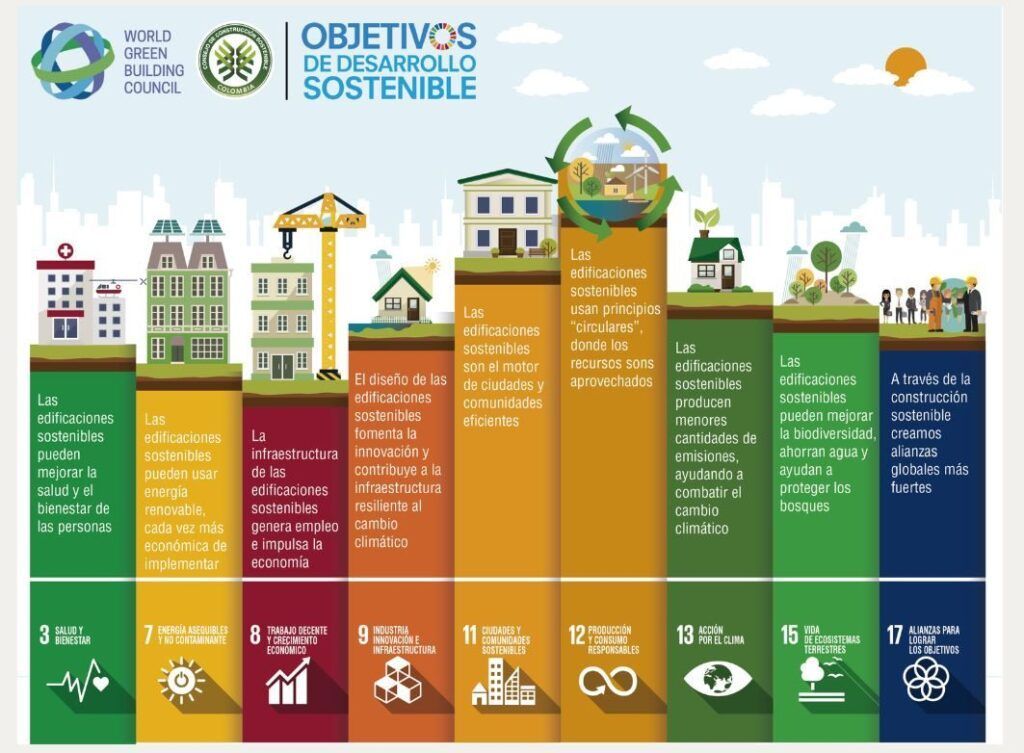
Sustainability in residential housing is not just a response to regulations, but a collective aspiration towards a healthier, greener and more livable future. Together we move towards a future where buildings, infrastructure and housing contribute to the construction of sustainable and prosperous communities. The 2030 Agenda for Sustainable Development, supported by 193 countries, represents a global commitment to address social, economic and environmental challenges. In Spain, the Government adopts these objectives as central principles, giving relevance to the 2030 Sustainable Development Strategy, approved in June 2021. In this context, the focus on building renovation, aligned with SDG 11, seeks to promote sustainable and inclusive cities.
The European Union (EU) widely adopts the development axes of the 2030 Agenda, applying them to continental public policies and orienting the 27 member countries towards these objectives. In the context of this report, we highlight specific objectives related to energy renovation. Building renovation emerges as a key element in addressing economic, social and environmental challenges:
- Objective 8: Promote sustainable economic growth and productive employment, emphasizing investment in human and technical resources that drive more sustainable economic growth.
- Objective nº 9: Building resilient infrastructures, promoting sustainable industrialisation and fostering innovation, with the development of industrialised processes to facilitate access to housing, the use of local materials and the development of innovative tools.
- Objective nº 11: To make cities inclusive, safe, resilient and sustainable, with a focus on affordable and healthy housing, inclusive planning and housing renovation for a more sustainable urban environment.
- Objective nº 12: Guarantee sustainable consumption and production patterns, with an emphasis on the design of buildings that increase their useful life, the reuse of materials and the development of solutions that reduce the use of non-renewable products.
- Goal nº 13: Adopt urgent measures to combat climate change, highlighting the integration of renewable energies, the use of local and renewable materials, and the efficient design of buildings to reduce energy demand.
- Objective nº 17: Strengthen the means of implementation and revitalize the Global Partnership for Sustainable Development, with an emphasis on building partnerships to advance these goals through the collaboration of industry and the private sector.
With ENVOLTA ENERGIA, for energy rehabilitation...
Housing renovation initiatives are key to mitigating the effects of climate change and contributing to European climate neutrality by 2050. Public aid from the EU, regional governments and city councils offers a framework conducive to sustainability, with significant incentives for energy efficiency and renovation projects. Renovation not only improves the quality of life and reduces energy consumption, but also provides positive economic and environmental value to properties.
For more information on how to improve energy efficiency and incorporate renewable energies into your home, contact Envolta Energia, facilitators of sustainable solutions for communities of owners, homes or companies.